
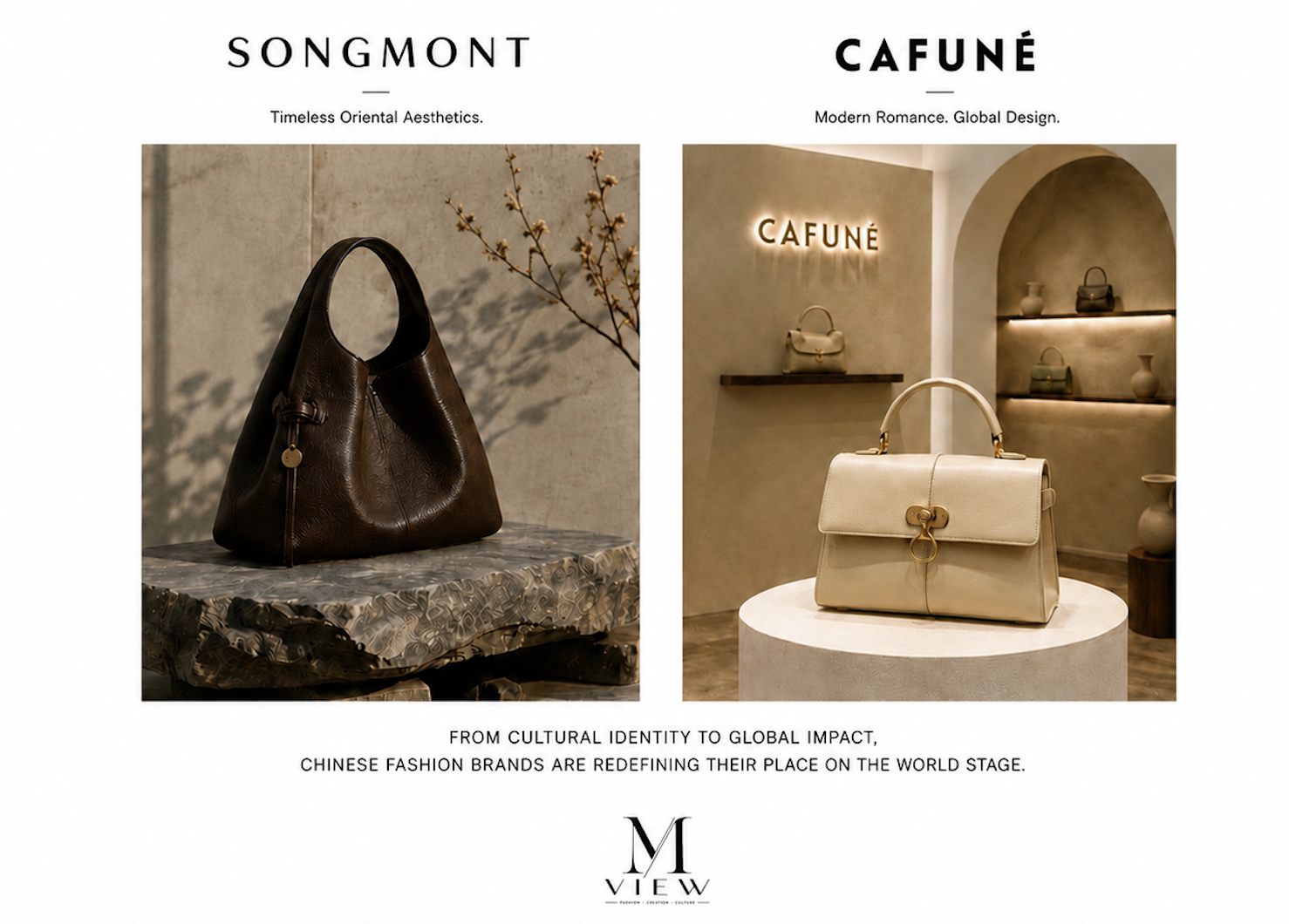
China's Fashion Brands Are Entering a New Global Chapter
Two strategies. One ambition: global presence.
For years, the international conversation around Chinese fashion was largely dominated by manufacturing, scale and the country’s enormous consumer market. Today, that narrative is changing.
A new generation of Chinese and Greater China fashion brands is increasingly building recognition around something different: design identity, cultural confidence and long-term brand value.
Songmont and Cafuné illustrate two distinct approaches to this evolution. One builds its universe around a contemporary interpretation of Chinese aesthetics; the other adopts a cosmopolitan design language conceived for an international audience.
Their strategies differ, but they point toward the same shift: Chinese fashion is moving from global production to global brand-building.
SONGMONT — Cultural identity as a global language
Songmont represents a particularly interesting evolution in contemporary Chinese accessories.
Rather than attempting to imitate the visual codes of established European luxury houses, the brand has developed an identity that draws on Chinese culture while presenting it through restrained, contemporary design.
Its approach reflects a broader change taking place among Chinese brands. Cultural references no longer need to be expressed through obvious symbols or decorative motifs. They can appear through proportions, materials, craftsmanship, storytelling and an overall sensibility.
This creates a quieter form of cultural confidence.
For international consumers, the appeal is therefore not simply that Songmont is a “Chinese brand.” Its potential lies in transforming a specific cultural point of view into products that can exist naturally within a global wardrobe.
That distinction is important.
The next stage of internationalisation for Chinese fashion may depend less on hiding its origins than on making those origins relevant to consumers who do not necessarily share the same cultural background.
CAFUNÉ — Designing beyond borders
Cafuné offers another route toward international recognition.
Founded in Hong Kong, the accessories label has developed a polished, contemporary identity centred on architectural shapes, recognizable hardware and an understated sense of femininity.
Its visual language feels deliberately international.
Rather than placing cultural origin at the centre of its communication, Cafuné demonstrates how a brand emerging from Greater China can participate directly in the global contemporary accessories market.
This reflects another important development: a Chinese or Hong Kong fashion identity does not have to look explicitly “Chinese” to have international significance.
For a younger generation of brands, geography is the starting point rather than the boundary of their creative identity.
Two strategies, one ambition
Songmont and Cafuné therefore represent two complementary models.
Songmont demonstrates the potential of transforming cultural identity into contemporary desirability. Cafuné shows how brands originating in Greater China can develop a design language that moves fluidly across markets.
Neither strategy is inherently stronger.
What matters is coherence.
International consumers increasingly encounter brands through social media, e-commerce, travel, celebrities and digital communities before they encounter them through traditional retail. In this environment, a distinctive product can travel extraordinarily quickly.
But visibility alone does not create a global brand.
The challenge is converting attention into recognition — and recognition into long-term desirability.
Beyond “Made in China”
This evolution also signals a deeper transformation in the perception of Chinese fashion.
For decades, “Made in China” primarily described where products were manufactured. The emerging question is what “Designed in China” — and eventually “Chinese luxury” — might mean culturally.
China possesses sophisticated manufacturing ecosystems, increasingly mature creative talent and one of the world’s most digitally advanced consumer markets. The opportunity now is to translate those strengths into brands capable of generating their own cultural value.
That requires more than expansion.
It requires storytelling, distribution, retail experience, consistent creative direction and, above all, a recognizable point of view.
The next chapter is about identity
The internationalisation of Chinese fashion should not simply mean opening stores in Paris, London, Milan or New York.
Its deeper significance will be measured by whether Chinese brands can become part of the global fashion conversation without losing what makes them distinctive.
Songmont and Cafuné suggest that there is no single formula.
Some brands will turn Chinese heritage into a contemporary design vocabulary. Others will emerge with identities that are naturally transnational from the beginning.
Both approaches challenge an older assumption that international success requires following Western luxury codes.
The more interesting possibility is the opposite.
As China’s fashion ecosystem matures, its strongest brands may not need to ask how to look global.
They may instead redefine what global fashion looks like.
M/VIEW
From cultural identity to global impact, Chinese fashion brands are redefining their place on the world stage.