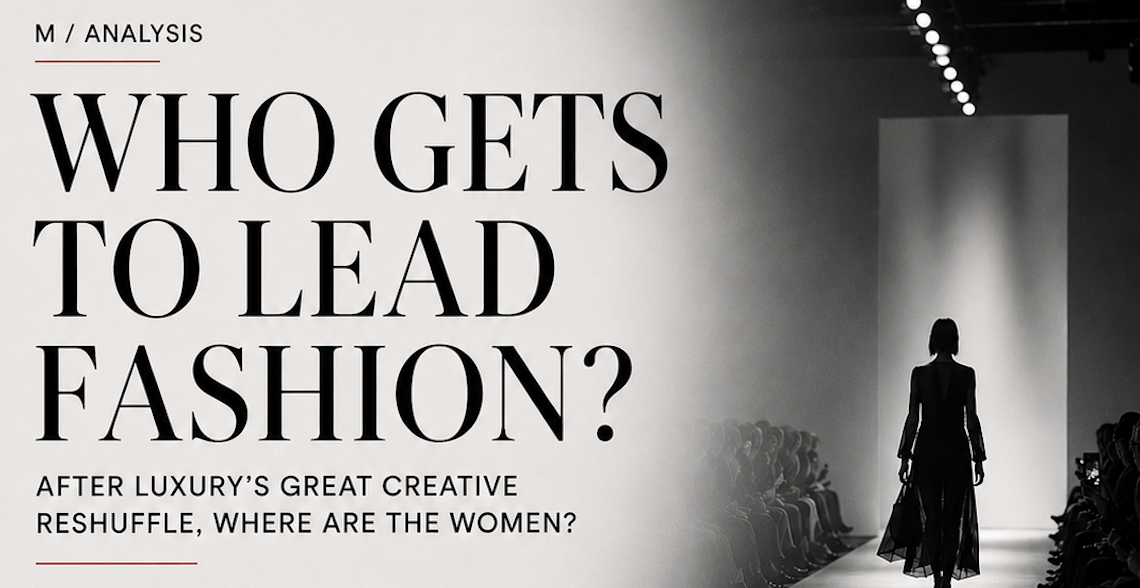
WHO GETS TO LEAD FASHION?
After luxury’s great creative reshuffle, where are the women?
Luxury fashion is entering one of its most significant periods of creative renewal in years. Across the industry, a new generation of designers is taking control of some of its most influential houses, promising new aesthetics, new strategies and, potentially, a new era.
But behind the excitement surrounding fashion’s creative reshuffle lies another question: who is being given the opportunity to lead?
From Chanel and Dior to Celine, Balenciaga and Loewe, many of the industry’s most visible recent appointments have gone to men. Matthieu Blazy has taken the creative helm at Chanel; Jonathan Anderson has entered Dior; Michael Rider is leading Celine; Pierpaolo Piccioli has joined Balenciaga; while Jack McCollough and Lazaro Hernandez have taken over at Loewe.
Individually, these appointments reflect different creative ambitions. Collectively, however, they reveal something about how leadership continues to be distributed at the highest level of luxury fashion.
A historic reshuffle
Creative directors have never carried more responsibility.
Today, they are expected not only to design collections, but to shape an entire cultural universe around a house: runway shows, campaigns, celebrity relationships, digital identity, collaborations and increasingly the commercial narrative surrounding the brand.
The recent wave of appointments therefore represents more than a change of aesthetics. It is a redistribution of cultural influence.
And this is precisely why representation at the top matters.
Fashion has long presented itself as an industry driven by experimentation and social change. Women make up a substantial part of its workforce, consumer base and creative community. Yet when the industry’s most prestigious creative positions become available, the shortlist of candidates visible to the public can appear considerably less diverse.
The contradiction is difficult to ignore.
Why does the imbalance persist?
The issue cannot simply be reduced to talent. There is no shortage of accomplished female designers.
Instead, the imbalance raises broader questions about how luxury groups identify and cultivate future creative directors.
Leading a major fashion house increasingly requires experience managing enormous collections, global teams, image-making and commercial expectations. Brands naturally look for candidates who have already demonstrated that capacity.
But this creates a circular problem: if leadership experience is required to obtain leadership positions, who is given the opportunity to acquire that experience in the first place?
The industry’s pipeline becomes as important as the final appointment.
Fashion schools may produce diverse generations of designers, but the path from emerging talent to the creative direction of a global luxury house remains narrow.
Beyond representation
The conversation should not become a simplistic opposition between male and female designers. Creative leadership cannot — and should not — be determined by gender alone.
The strongest appointment must ultimately be one capable of understanding a house’s heritage while imagining its future.
But diversity matters precisely because fashion depends on perspective.
Different backgrounds, experiences and ways of seeing the world can produce different interpretations of beauty, identity and contemporary culture. When leadership becomes concentrated among similar profiles, the industry risks narrowing the creative vocabulary it claims to constantly reinvent.
The question, therefore, is not whether the men appointed to these positions deserve them.
It is whether the system is creating enough opportunities for a broader range of designers to become credible candidates for those positions.
The next generation of fashion leadership
The current creative-director reshuffle will define luxury fashion for years to come. New collections will arrive, new visual identities will emerge, and some appointments will inevitably prove more successful than others.
But another transformation may be equally important.
Luxury groups will increasingly be judged not only by the creativity of the people they appoint, but by the ecosystems of talent they build around them.
Who receives mentorship? Who gains responsibility inside studios? Who is allowed to develop a recognizable creative voice? And ultimately, who gets the opportunity to lead?
Fashion has always celebrated change on the runway.
Its next challenge may be ensuring that change reaches the institutions behind it.
M VIEW
Fashion is changing. So should leadership.