
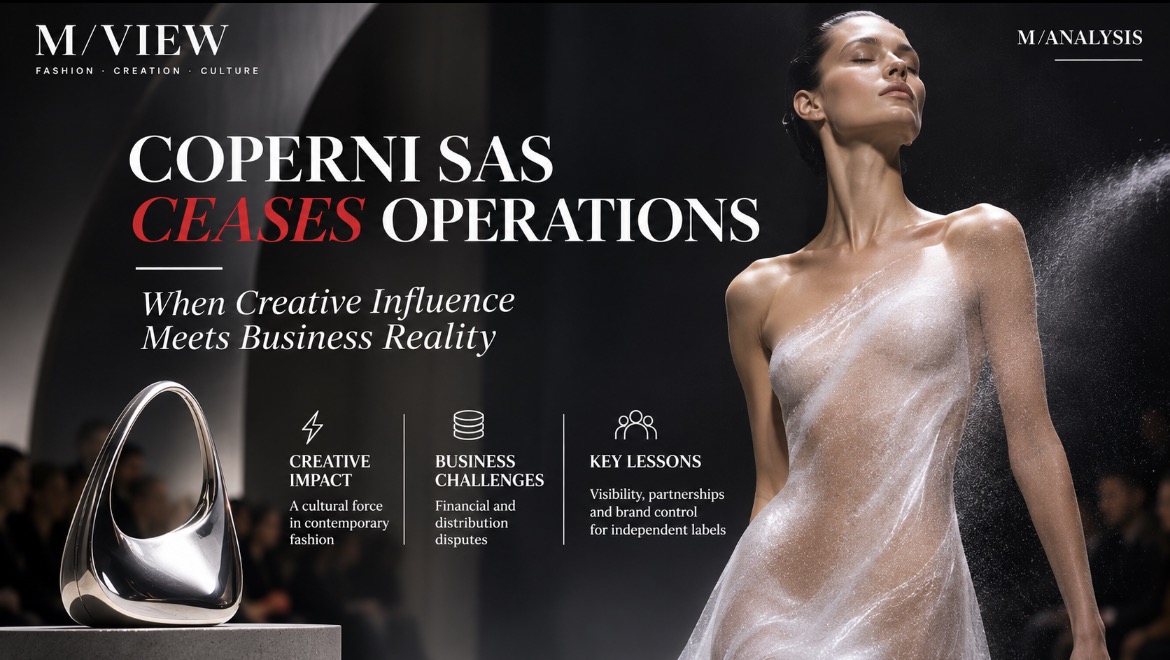
Coperni: When Creative Influence Meets Business Reality
Why the closure of Coperni SAS raises difficult questions about ownership, distribution and the future of independent fashion.
On November 4, French fashion label Coperni announced the cessation of operations at Coperni SAS, its French operating company. The announcement followed months of unresolved tensions between co-founders Sébastien Meyer and Arnaud Vaillant and Tomorrow, the brand’s majority shareholder and exclusive distributor.
For a label celebrated for some of fashion’s most memorable runway moments, the news raises an uncomfortable question: how can a brand achieve global cultural recognition while remaining financially vulnerable?
A Brand That Understood the Power of Fashion Spectacle
Founded in 2013 and later relaunched, Coperni developed a distinctive creative identity at the intersection of fashion, technology and contemporary culture.
Its Spring/Summer 2023 presentation became an international media phenomenon when a dress was sprayed directly onto Bella Hadid’s body during the show.
The brand continued experimenting with unconventional materials, futuristic accessories and immersive runway formats. The Swipe Bag became a recognisable design signature, while its Air Swipe Bag demonstrated the possibilities of advanced materials.
Coperni understood something fundamental about contemporary fashion: a runway show could function as a cultural event, extending a brand’s reach far beyond the traditional fashion audience.
But creative visibility and business resilience are not interchangeable.

The Commercial Structure Behind the Crisis
Coperni’s difficulties emerged within a complex ownership and distribution arrangement.
Tomorrow had served as the brand’s majority shareholder and exclusive distributor since 2019. Under the commercial structure described in industry reporting, Tomorrow collected revenues and paid amounts due to the brand according to contractual arrangements.
According to Coperni’s founders, the relationship deteriorated amid disputed payments and the termination of a licensing agreement.
In June 2026, Coperni entered court-supervised restructuring in Paris. The founders subsequently sought a solution that would allow them to regain control of the brand.
Those efforts did not produce an agreement.
The French operating company entered judicial liquidation in late October, and the founders publicly announced the cessation of operations on November 4.
The distinction matters: the cessation of Coperni SAS does not, by itself, establish the ultimate fate of the brand’s intellectual property or determine whether its creative identity might reappear under a different business structure.
Visibility Is Not the Same as Financial Stability
Coperni’s case illustrates a structural challenge facing emerging and independent fashion labels.
Media attention can create desirability, attract customers and strengthen a brand’s cultural relevance. Yet converting that visibility into sustainable operations requires consistent revenues, appropriate margins, reliable distribution and disciplined cash-flow management.
Fashion shows and creative campaigns also require substantial investment, often before the resulting collections generate revenue.
For independent designers, the challenge is therefore not simply how to become visible, but how to finance and sustain that visibility.
When Distribution Becomes a Question of Control
Commercial partners can offer young brands valuable access to production, international buyers, sales networks and financing.
These resources may accelerate growth beyond what an independent studio could achieve alone.
However, the same partnerships can introduce dependencies.
When ownership, licensing, revenue collection and distribution are concentrated within a commercial partner, disagreements can affect the designer’s ability to operate, invest and plan future collections.
Coperni’s situation demonstrates why the governance of these relationships deserves as much attention as their potential for expansion.
The specific contractual responsibilities and disputed payments remain matters that should be assessed through the relevant legal and commercial records, rather than reduced to a single explanation.
What Independent Designers Can Learn
Three broader lessons emerge.
First, creative success should be supported by a business model that can withstand disruption. Revenue diversification, cash reserves and realistic investment planning are essential.
Second, distribution agreements must be evaluated beyond immediate market access. Payment terms, reporting transparency, intellectual property rights and exit provisions can become decisive.
Third, preserving a meaningful degree of strategic control matters. Creative directors may define a brand’s identity, but ownership and governance determine who can make critical decisions when commercial relationships deteriorate.
These lessons are particularly relevant to emerging designers entering international markets, where unfamiliar legal structures and complex distribution partnerships can create additional risks.
M/VIEW Perspective: Beyond the Viral Moment
Coperni’s creative achievements remain significant. The brand helped demonstrate how fashion could intersect with technology, performance and digital culture in ways that captured global attention.
Its operational crisis does not diminish that contribution.
Instead, it exposes the distance that can exist between cultural success and commercial security.
The next generation of independent fashion brands will need to develop both: a compelling creative vision and a structure capable of sustaining it.
The real measure of a fashion brand is not only how powerfully it captures attention, but how successfully it converts creative relevance into lasting value.
M/VIEW — Fashion · Creation · Culture
Editorial note: This analysis reflects publicly reported information available on November 5, 2026. Allegations regarding contractual payments are attributed to the founders. The future of the Coperni brand name and intellectual property has not been conclusively established.