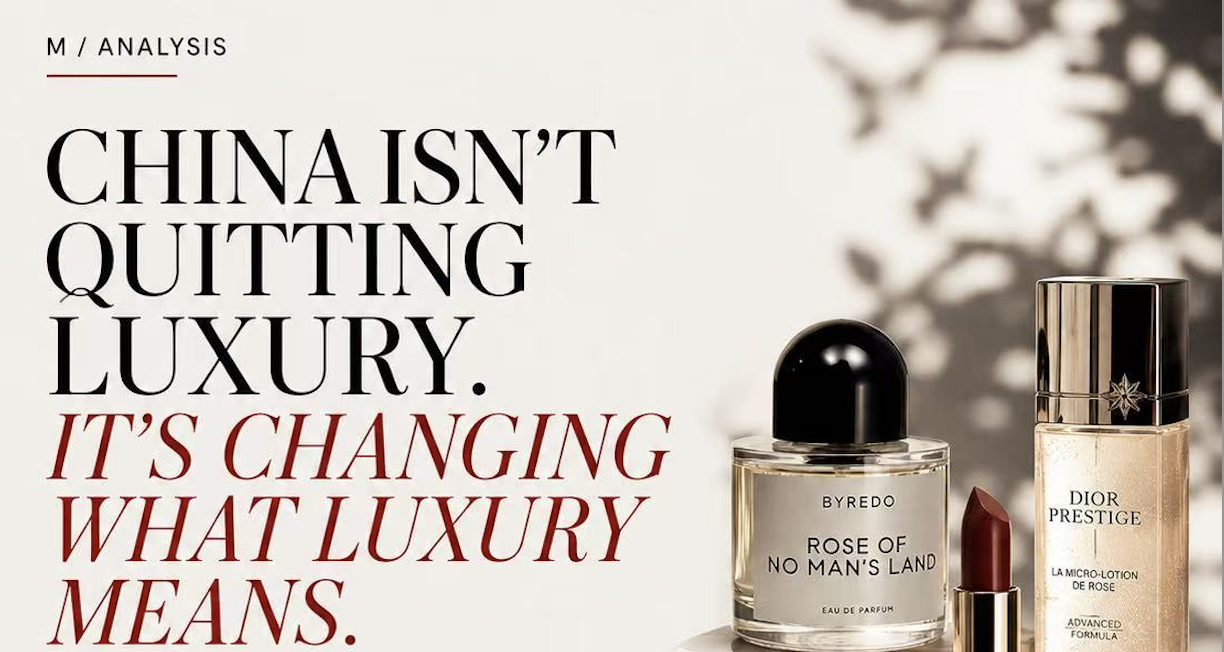
China Isn’t Quitting Luxury, It’s Changing What Luxury Means
Chinese consumers are not simply spending less. They are becoming more selective — shifting from visible status purchases toward prestige beauty, experience, quality and products that feel worth the investment.
For more than a decade, China was one of the most powerful engines of global luxury growth. Designer handbags, watches, jewellery and fashion became symbols of a rapidly expanding affluent and aspirational consumer class.
That relationship is now changing.
The conventional narrative says Chinese consumers are retreating from luxury. The reality is more nuanced: they have not necessarily abandoned the desire for premium products. They are reconsidering which products deserve their money.
One of the clearest signs of this transformation is emerging at the beauty counter.
Research cited by Reuters from Oliver Wyman and the Tax Free World Association found that 37% of affluent Chinese consumers intend to increase spending on prestige beauty over the coming year, compared with just 4% who plan to spend more on leather goods.
That gap tells a much bigger story about the future of luxury in China.
From the Handbag to the Beauty Counter
Prestige skincare, fragrance and cosmetics occupy an interesting position in the luxury hierarchy.
They provide consumers with access to exceptional ingredients, sophisticated branding and the emotional experience associated with luxury — but at a considerably lower financial commitment than a handbag or watch.
This matters in an environment where economic uncertainty and the prolonged property downturn have made even affluent consumers more conscious of price and value.
A €250 skincare product and a €4,000 handbag may both belong to the luxury universe, but the psychology behind purchasing them is very different.
Beauty is frequently consumed and replenished. It can be framed as self-care or personal investment. A handbag is a much larger discretionary purchase — and one that can easily be postponed.
The Chinese consumer therefore may not be trading down.
They may instead be trading up within a category they consider worth buying.
The Rise of “Small Luxury”
This creates an important opportunity for what might be called small luxury: premium products that deliver an elevated experience without requiring the financial commitment associated with traditional luxury goods.
Fragrance is particularly well positioned.
A sophisticated perfume can communicate taste, identity and exclusivity in much the same way fashion once did — while remaining accessible to a much larger audience.
Recent results reinforce the trend. Estée Lauder has reported strong demand for luxury fragrance and skincare, with China contributing to the momentum; its upscale fragrance business recorded double-digit growth in its latest reported quarter.
The implication is significant.
The gateway into luxury may increasingly be a fragrance, serum or experience rather than a handbag.
From YOLO to YONO
Perhaps the most revealing change is psychological.
The previous era of rapid luxury expansion was closely connected to abundance: new products, new collections and frequent purchases.
Today, a different mentality is emerging.
YOLO — You Only Live Once.
Buy it because you want it.
Increasingly, this is being challenged by another idea:
YONO — You Only Need One.
Buy fewer things. But make the one you buy meaningful.
The shift does not necessarily mean consumers have become anti-luxury. It means the justification for luxury is becoming more demanding.